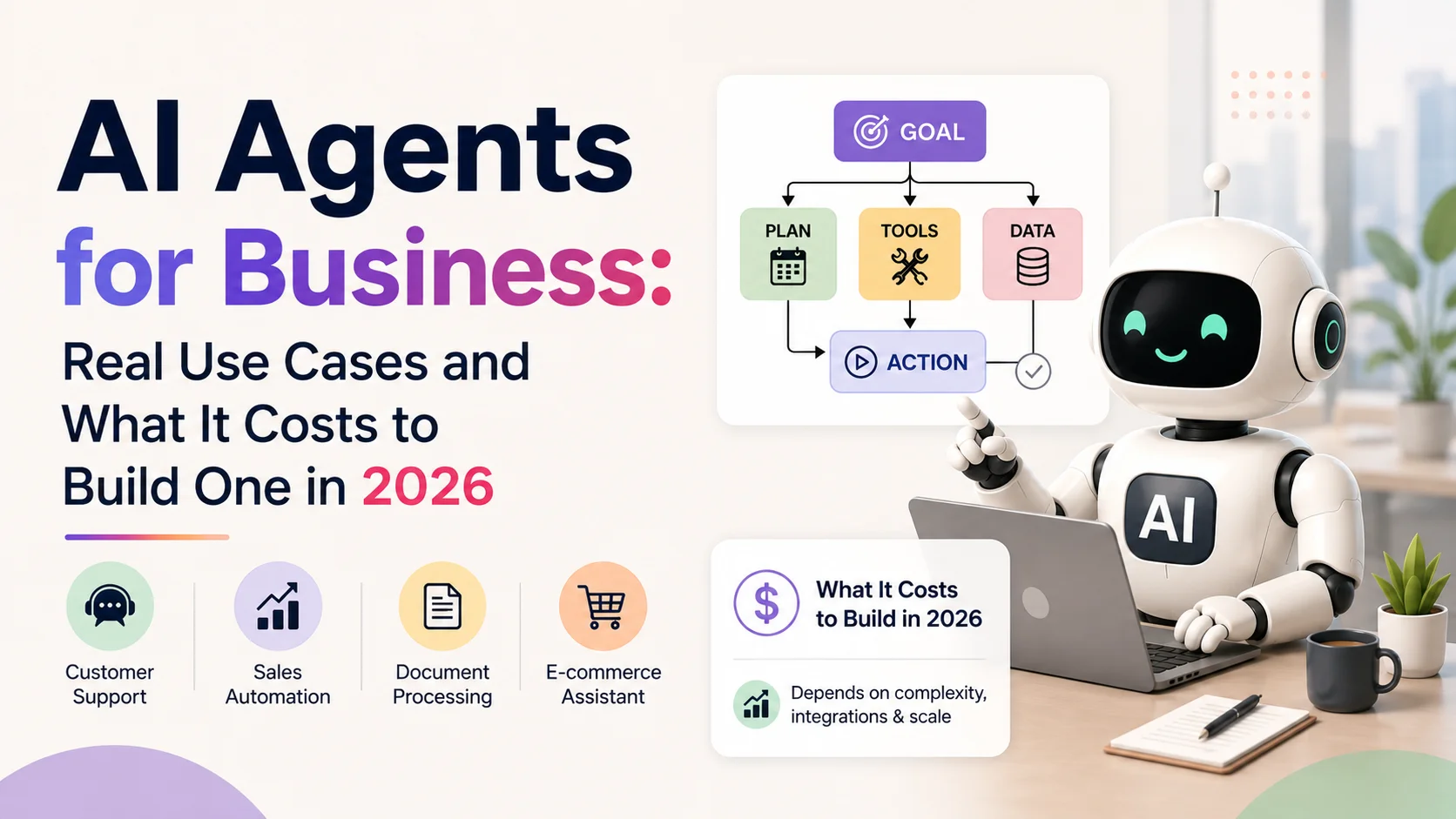
Most business owners asking about AI development are not looking for a technical definition. They want to know what it will actually change. In 2026 that question has a clearer answer than it did even 18 months ago, because the companies that started AI projects in 2024 and 2025 are now seeing measurable results, and the patterns are consistent enough to be useful.
This guide covers five areas where AI development creates the most tangible business value. It is written for founders, product leaders, and operators who need to make investment decisions, not for engineers building the models.
What AI Development Actually Means for a Business
AI development is the process of building software systems that learn from data rather than following a fixed set of rules. That distinction matters because it means AI can handle tasks that are too variable, too complex, or too large in scale for traditional software to manage well.
When a business invests in AI development, it is typically doing one or more of these things: automating a process that currently requires human judgment, building a product feature that personalises based on user behaviour, extracting insights from data that is too large to analyse manually, or creating a capability that competitors cannot easily replicate.
The value is almost always one of four things: time saved, decisions made better, a customer experience that earns more revenue, or a moat that makes the business harder to displace. Understanding which one applies to your situation is the starting point for any serious AI investment.
Area 1: Automating Repetitive Operations
The most immediate and measurable return from AI development is process automation. This is different from traditional automation in one important way: AI handles variation. A traditional rule-based system breaks when the input does not match what the rules expect. An AI-powered system handles documents in 12 different formats, emails written in three different languages, or product images with inconsistent quality, because it learned from examples of the variation rather than being programmed to expect consistent, predictable input.
Common targets for AI automation include document processing, customer support triage, data extraction, compliance checks, invoice processing, and scheduling coordination. A document intelligence system our team built for a US insurance firm cut manual review time by 70 percent in its first month of operation. The pipeline handled claims forms, policy documents, and legal correspondence that previously required a large manual review queue.
The signal that a process is ready for AI automation is usually this: a human can do it reliably, but doing it at scale requires more humans in a linear relationship with volume. AI breaks that linearity. Volume can grow significantly without proportional headcount growth, which is where the economics become compelling.
Area 2: Making Better Decisions Faster
AI development enables businesses to make decisions based on patterns in large datasets rather than intuition or small samples. This shows up in credit scoring, inventory management, pricing, fraud detection, and demand forecasting. The decisions are not automatically better because AI is involved, but they are faster, more consistent, and based on more data than any individual analyst could process in the same time window.
The key requirement here is data quality. An AI decision support system is only as good as the data it was trained on. Businesses that have invested in clean, well-structured historical data get dramatically better results from AI than those that try to bolt AI onto messy pipelines. This is why data engineering is often the first investment before AI development begins in earnest.
Decision support AI also has an important characteristic worth understanding: it does not need to be perfect to be valuable. A fraud detection model that catches 85 percent of fraud cases with a manageable false positive rate is enormously useful even if it misses 15 percent, because the alternative is catching zero percent automatically.
Area 3: Personalising the Customer Experience at Scale
Personalisation at scale was previously only possible for large companies with enormous engineering teams and massive data infrastructure budgets. AI development has changed that. A mid-size e-commerce business can now run recommendation models that adapt to individual user behaviour. A SaaS company can surface different onboarding paths based on what the system has learned about which paths lead to product activation. A healthcare app can adjust reminders and content based on what each specific user actually engages with.
The commercial impact of personalisation is well documented. Research from McKinsey Global Institute has consistently found that companies excelling at personalisation generate significantly more revenue than those that do not. Users who engage with personalised product recommendations convert at higher rates and carry higher average order values. The same pattern holds in content discovery, onboarding, and long-term retention contexts.
For businesses evaluating AI investment, personalisation is often the area with the clearest revenue connection and the shortest path from development effort to a measurable business outcome. It is also one of the areas where the quality of the data architecture built into the product from day one has the biggest impact on what the AI can actually do.
Area 4: Creating New Revenue Streams
Some of the most valuable applications of AI development are not about improving existing processes but about building capabilities that were not possible before. An AI-powered feature can become a product in its own right, or a significant reason customers choose one platform over another in a competitive market.
Examples include: a logistics platform adding AI route optimisation as a premium service tier; an e-commerce tool offering AI-generated product descriptions as a paid feature for merchants; an HR software company adding predictive attrition modelling that enterprise clients pay a premium to access. In each case the AI capability creates a revenue line that did not exist before the development investment.
The pattern is consistent: businesses that treat AI as a product feature rather than just an internal efficiency tool tend to capture more of the total value. Internal automation saves money. External AI features generate revenue. Both matter, but the compounding value of the second is often underestimated in the initial business case.
Area 5: Building a Competitive Advantage That Compounds
Advantages built on AI development are often harder to copy than those built on features alone. The reason is data. A competitor can replicate your feature list in six months. They cannot replicate six months of your users interacting with your AI model, generating the training signal that makes the model better at your specific use case. The longer a well-designed AI system runs on real production data, the harder it becomes to replicate its performance starting from scratch.
This is why timing matters more than it appears to. Companies that build AI capabilities earlier accumulate a data advantage that compounds over time. The companies waiting to see what the technology matures into are not just delaying the investment. They are delaying the accumulation of the proprietary data that makes the investment worthwhile when they eventually do make it.
This does not mean building AI for the sake of building it. But it does mean the cost of waiting is not zero, and the first-mover advantage in AI is real in markets where the training data is proprietary to the business that collects it.
Common Mistakes to Avoid in 2026
- Starting with the technology rather than the problem. The question is never “where can we use AI” but “what is the most expensive or error-prone thing we do that AI might materially improve.”
- Underestimating data readiness. Most AI projects take longer than expected because of data problems, not model problems. Budget time and resource for data cleaning and pipeline work before model training begins.
- Shipping a demo rather than a production system. A prototype that works with 1,000 clean records is very different from a system that handles 100,000 messy ones reliably and at scale.
- Measuring inputs rather than outcomes. The metric is not “we deployed a model.” It is the business result: cost per claim processed, conversion rate, time saved per week, revenue attributable to the feature.
- Treating AI as a one-time project rather than an ongoing capability. Models need monitoring, retraining as data drifts, and iteration based on what production performance actually shows.
How to Get Started
The most effective first step is identifying one high-value, clearly scoped problem where you already have reasonably clean data. Not the biggest AI project you could imagine, but the one that would create the most business value if it worked, and that you could realistically measure within 90 days of going live in production.
Starting small does not mean thinking small. It means validating the investment thesis with something real before scaling it. The businesses that get the most from AI development are usually the ones that shipped something modest, learned from it in production, and then expanded from a position of understanding rather than assumption.
Our AI development team has shipped production systems across healthcare, e-commerce, logistics, FinTech, and HR. If you want a realistic view of what is worth building and what order to build it in, a free consultation is the fastest way to get there. We will tell you honestly what fits and what does not, including if we think the timing is wrong for what you are considering.
Our engineering team has hands-on experience with the topics covered in this article. If you have a project in mind, we would be happy to give you honest feedback on scope, timeline, and feasibility. No commitment required.