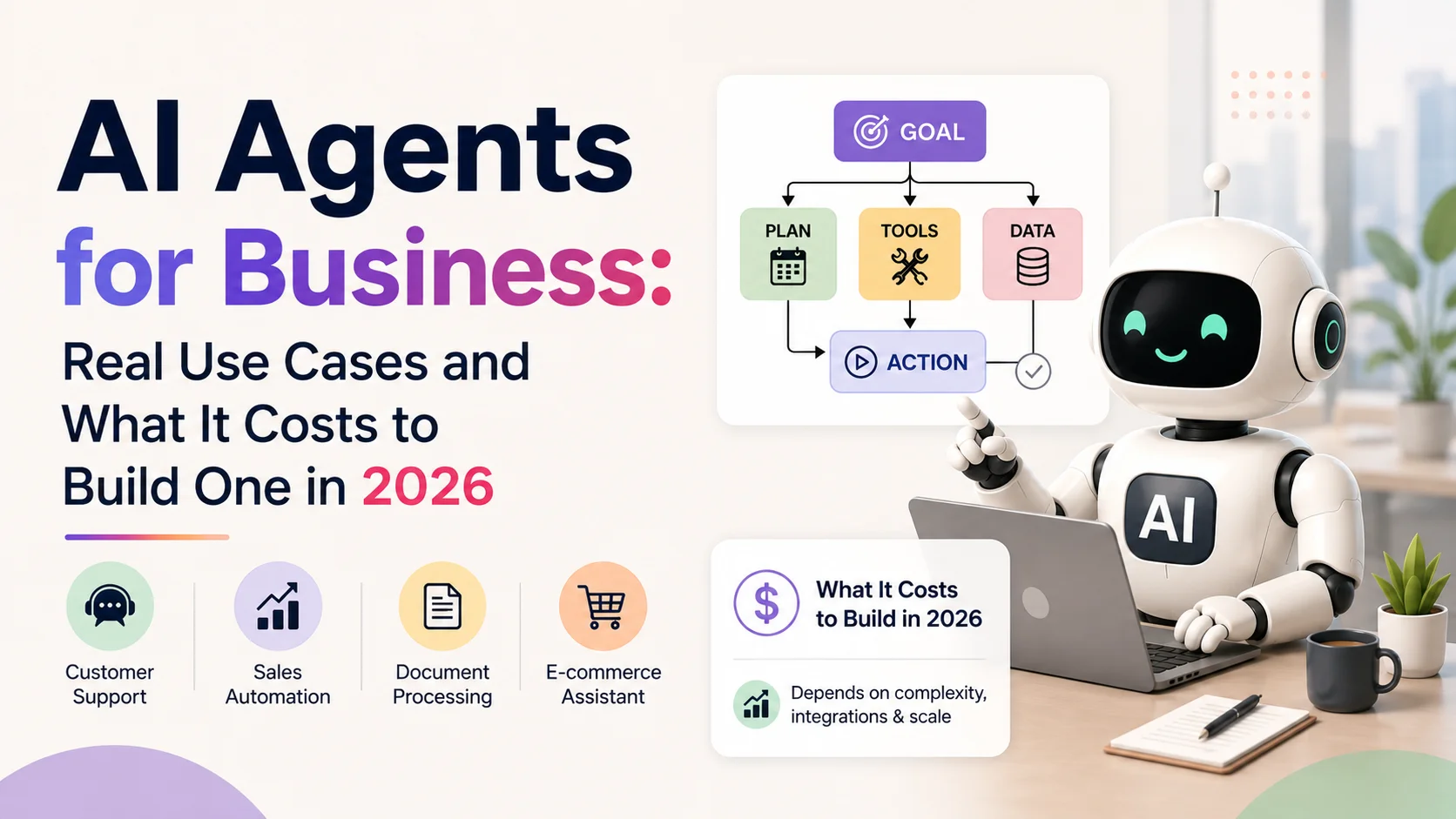
If you have been hearing the term “AI development” a lot lately and are not entirely sure what it means in practical terms, you are not alone. Artificial intelligence has become one of those phrases that gets attached to almost everything, which makes it harder to understand what it actually involves when a business decides to build an AI-powered product or feature. This guide breaks it down in a straightforward way so you can go from vague awareness to a clear picture of what AI development is, what it involves, and when it makes sense for your business.
The Short Answer
AI development is the process of designing, building, training, and deploying software systems that can perform tasks that typically require human intelligence. These tasks include recognizing patterns in data, understanding natural language, making predictions, generating content, classifying information, and making decisions based on context.
The “development” part covers everything from choosing the right approach and preparing data, to writing code, training models, testing accuracy, and eventually putting the finished system into production where real users can interact with it.
How AI Development Differs from Traditional Software Development
In traditional software development, a programmer writes explicit rules. If a user clicks a button, show this screen. If a value exceeds a threshold, send an alert. The behavior is deterministic and fully defined by code.
AI development works differently. Instead of writing rules, the team feeds the system examples and lets it learn the rules on its own. A spam filter is not programmed with a list of forbidden words. It is trained on thousands of emails that humans have already labeled as spam or not spam, and it learns to recognize the patterns that distinguish the two.
This shift from explicit rules to learned patterns is what makes AI systems powerful and also what makes developing them a genuinely different discipline from standard programming.
The Core Stages of an AI Development Project
1. Problem Definition
Every AI project should begin with a clear statement of the problem being solved. This sounds obvious, but many projects go wrong here. “We want to use AI” is not a problem statement. “We want to reduce the time our support team spends answering repetitive questions by automatically classifying and routing incoming tickets” is a problem statement. The more specific you can be, the better the outcome.
2. Data Collection and Preparation
AI systems learn from data, so data is the foundation of the entire project. This stage involves identifying what data you have, collecting more if needed, cleaning it to remove errors and inconsistencies, and structuring it in a way the model can use. In practice, this step takes more time than most clients expect. Clean, well-labeled data is genuinely hard to produce, and it has an enormous impact on how well the final system performs.
3. Choosing an Approach
Not all AI is the same. Depending on the problem, a team might use supervised learning (where labeled examples teach the model), unsupervised learning (where the model finds patterns without labels), reinforcement learning (where the model learns through trial and error), or one of the many pre-trained large language models that can be fine-tuned for specific tasks. Picking the right approach for the problem and the available data is one of the most important decisions in the project.
4. Model Training
Training is the process of running data through a model repeatedly so it can adjust its internal parameters and improve its accuracy. This requires computational resources (often GPUs or cloud infrastructure), careful selection of model architecture, and a lot of experimentation with settings called hyperparameters. Teams evaluate progress by measuring performance on a validation dataset that the model has not seen during training.
5. Evaluation and Testing
Once a model reaches acceptable accuracy on the validation set, it gets tested on a separate holdout dataset to check that it generalizes well to new information. Beyond raw accuracy, the team also checks for bias, robustness under edge cases, and behavior when inputs are unusual or incomplete. This stage often surfaces issues that send the team back to the data preparation stage to fix problems at the source.
6. Integration and Deployment
A trained model on its own is not a product. It needs to be wrapped in an API or embedded directly into an application so that real users can interact with it. This stage involves engineering work to make the model serve predictions reliably at scale, handle failures gracefully, and log enough information to monitor performance over time.
7. Monitoring and Retraining
AI systems degrade over time as the real world changes and the data the model was trained on becomes less representative of current conditions. A good AI development process includes monitoring for drift, setting up alerts when performance drops below acceptable thresholds, and a pipeline to retrain the model on fresh data when needed. This is why AI development is often described as a continuous process rather than a one-time project.
Common Types of AI Systems Built for Businesses
To make this more concrete, here are the kinds of systems that businesses actually build through AI development:
- Recommendation engines that suggest products, content, or actions based on user behavior
- Natural language processing systems that read, classify, summarize, or generate text
- Computer vision systems that analyze images or video for defects, objects, or patterns
- Predictive models that forecast demand, churn, fraud, or equipment failure
- Conversational AI including chatbots and virtual assistants powered by large language models
- Document processing systems that extract structured data from invoices, contracts, or forms
Each of these has its own technical requirements, data needs, and evaluation criteria. The right team will help you understand which type of system maps to your specific problem before committing to an approach.
What Skills Does AI Development Require?
A complete AI development team typically brings together several different skill sets. Data engineers build and maintain the pipelines that collect and process raw data. Data scientists and machine learning engineers design models, run experiments, and evaluate results. Software engineers build the infrastructure that makes models accessible and reliable in production. Domain experts (often from the client side) provide the business context and label training data in ways that reflect real-world nuance. Project managers coordinate the work and keep expectations aligned across technical and business stakeholders.
This is one reason businesses frequently work with specialized AI development companies rather than trying to hire all of these roles independently. A dedicated team that has worked together across many projects tends to move faster and make fewer expensive mistakes than a team assembled from scratch.
How Long Does an AI Development Project Take?
This depends heavily on complexity, data availability, and how well-defined the problem is. A simple classification model with clean existing data might reach a working prototype in four to six weeks. A custom large language model fine-tuned on proprietary data and integrated into a production application could take four to six months or longer. Most real projects fall somewhere in between.
The best teams are honest about timelines upfront and structure projects in phases so you can evaluate progress and adjust direction before committing to the full scope.
When Does AI Development Make Sense for Your Business?
AI development is not the right answer to every problem. It makes the most sense when you have a well-defined, repeatable task where human judgment is currently the bottleneck, you have access to enough relevant historical data to train a model, the cost of mistakes is manageable and you can measure accuracy objectively, and the volume of cases is high enough that automation delivers meaningful value. If your problem does not meet these conditions, a simpler rule-based system or process improvement might serve you better. A good AI development partner will tell you that honestly rather than selling you a project you do not need.
Getting Started
The best starting point for most businesses is a short discovery engagement where a technical team reviews your data, maps out the problem clearly, and returns a realistic assessment of what AI can and cannot do for your specific situation. This protects you from investing in a full build before you know whether the fundamentals are in place.
If you are thinking about an AI-powered feature or product and want a straightforward conversation about what it would involve, we are happy to help. Reach out through our contact page and we will come back to you within one business day.
Our engineering team has hands-on experience with the topics covered in this article. If you have a project in mind, we would be happy to give you honest feedback on scope, timeline, and feasibility. No commitment required.