Large language models have moved from research curiosity to production infrastructure faster than almost any technology in the last decade. In 2026, the question most enterprise teams face is no longer whether to integrate LLMs into their products and workflows but how to do it well, at what cost, with what security posture, and in a way that does not create more problems than it solves.
This guide covers the full picture of LLM integration for enterprise applications: the architectural choices, the tradeoffs between retrieval augmented generation and fine-tuning, the security and data privacy considerations that enterprise contexts demand, and the cost and latency factors that determine whether a production LLM integration is actually viable at scale.
What LLM Integration Actually Means in Practice
LLM integration means connecting a large language model, whether a hosted API like GPT-4 or Claude, or a self-hosted open-source model like Llama or Mistral, to a software application in a way that adds intelligent language understanding or generation capabilities to the product. The integration can range from a simple API call that sends text and receives a response, to a sophisticated multi-step pipeline that retrieves relevant context from a vector database, passes it to the model along with a carefully engineered prompt, and then processes and validates the model output before surfacing it to the user.
The complexity of the integration should match the complexity of the task. Simple use cases, such as generating a first draft of a product description or summarising a support ticket, can often be handled with a direct API call and a well-crafted prompt. Complex use cases, such as answering questions accurately from a large proprietary knowledge base, routing support queries based on content and intent, or generating structured outputs for downstream systems, almost always require more careful architecture.
RAG versus Fine-Tuning: Understanding the Real Tradeoff
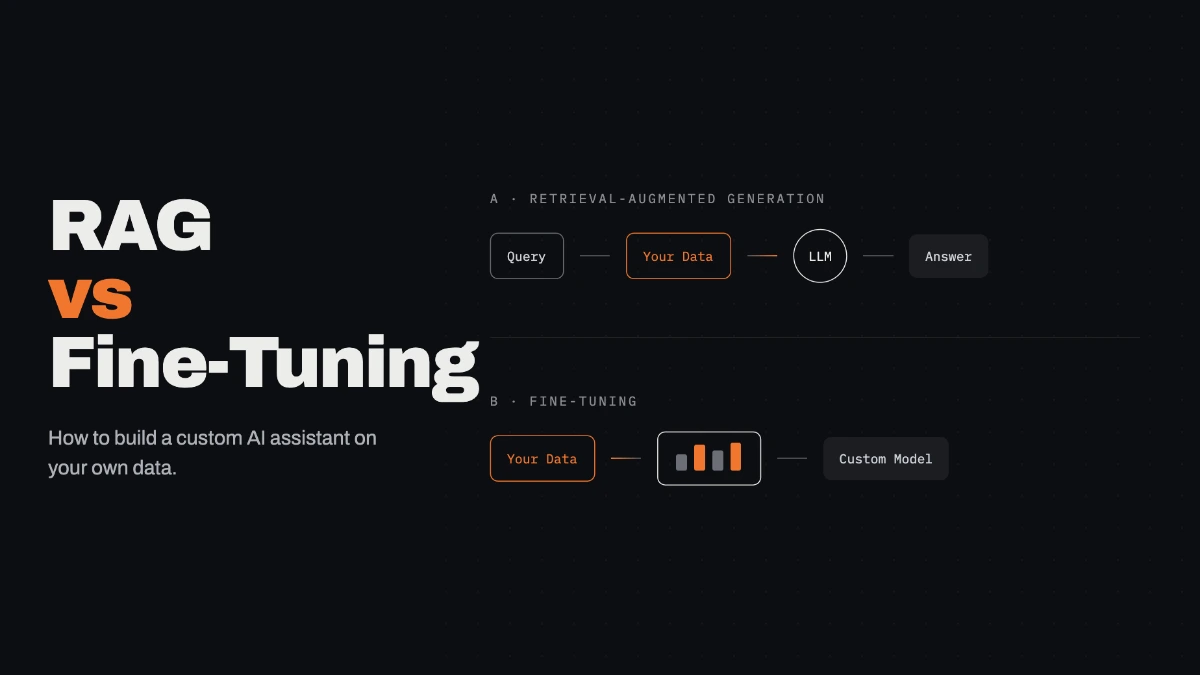
The most important architectural decision in most enterprise LLM integrations is whether to use retrieval augmented generation, commonly called RAG, or fine-tuning, or a combination of both.
RAG works by retrieving relevant documents or passages from a knowledge base at query time and passing them to the language model as context along with the user question. The model generates a response grounded in the retrieved content rather than relying solely on what it learned during pre-training. This approach works well when the knowledge the model needs to draw on is in documents that can be indexed, the information changes over time and needs to stay current without retraining, and the use case requires the model to cite specific sources or ground its answer in specific content.
Fine-tuning works by training an existing pre-trained model on a new dataset of examples specific to your domain, use case, or desired response style. This adapts the model behaviour in ways that prompt engineering and RAG cannot achieve: consistent terminology and tone, correct handling of domain-specific edge cases, structured output formats that require reliable consistency. Fine-tuning is the right choice when you need the model to behave in a very specific, consistent way that cannot be achieved through prompting alone, when the task is narrow and well-defined enough that a focused dataset covers the variation, and when you have the domain-specific labelled data required to do it well.
In practice, most production LLM systems use both. RAG provides access to current, proprietary information. Fine-tuning ensures the model responds in the right format, with the right vocabulary, at the right level of detail for the specific use case. A customer service bot might be fine-tuned on historical support interactions to match the company communication style and then augmented with RAG over the current product documentation to ensure factual accuracy.
Security and Data Privacy in Enterprise LLM Contexts
Security and data privacy are where LLM integration often becomes complicated for enterprise teams, particularly those in regulated industries.
The core concern is data leaving your environment. When you call a hosted LLM API, the text you send in the prompt is processed on the provider infrastructure. For most general business tasks this is acceptable. For use cases involving patient health information, financial records, personally identifiable information, or proprietary competitive data, sending that content to a third-party API may violate your regulatory obligations, your customer agreements, or your own data governance policies.
The solutions to this problem range from careful prompt design that avoids including sensitive data directly, to using a provider with a data processing agreement that meets your compliance requirements, to deploying a self-hosted open-source model within your own infrastructure where no data leaves your environment. Each option involves tradeoffs: capability, cost, latency, and operational complexity. The right choice depends on your specific regulatory context and the sensitivity of the data flowing through the system.
Prompt injection is a security risk specific to LLM systems that enterprise teams need to understand. A prompt injection attack occurs when user-supplied input is included in a prompt in a way that causes the model to follow attacker instructions rather than the application instructions. This can cause a model to leak system prompts, ignore safety constraints, or take unintended actions in an agentic context. Mitigating prompt injection requires careful prompt architecture, input validation, and in many cases a separate model or rule layer that validates the output before it is acted upon.
Cost and Latency at Scale
LLM integration economics change significantly as usage scales. An API call that costs a fraction of a cent per query sounds trivial until it becomes millions of queries per day. Understanding the cost structure of your chosen model at realistic production volume is a required step before committing to a hosted API architecture.
The cost of a hosted LLM API is typically measured in tokens, where a token is roughly three to four characters of text. Input tokens, the text you send in the prompt, and output tokens, the text the model generates, are both priced. Long system prompts, retrieved context passages in RAG, and verbose model outputs all increase token consumption. Optimising prompt length and output length is one of the most effective ways to manage API costs at scale.
Latency matters in interactive use cases where users are waiting for a response. Modern hosted LLMs typically add 500 milliseconds to several seconds of latency depending on the model and the output length. For a background document processing pipeline this is usually acceptable. For a customer-facing chat interface where the user is watching a cursor blink, streaming responses and careful choice of the right model size for the task can make the difference between an experience that feels acceptable and one that feels broken.
Caching is one of the most underused tools in LLM cost and latency management. Many enterprise LLM use cases involve the same system prompts and context being sent repeatedly with only the user query changing. Prompt caching, available through providers including Anthropic, can significantly reduce both cost and latency for these patterns by reusing computation on repeated prefixes rather than reprocessing the same content on every request.
A Practical Integration Approach
The most reliable path to a production LLM integration follows a sequence that enterprise teams often want to compress but should not.
Start with a clearly scoped use case with a defined evaluation method. You need to know what good performance looks like before you can tell whether your integration achieves it. For a question-answering system this might be accuracy on a test set of representative questions with known answers. For a document classification system this might be precision and recall against a labelled validation set.
Build and evaluate the simplest version first. Start with direct API calls and well-engineered prompts before adding RAG, fine-tuning, or orchestration complexity. Many use cases can be solved well with good prompt engineering and do not need a vector database and an embedding pipeline. Add complexity only when the simpler approach has demonstrably hit its ceiling.
Build for observability from the beginning. Log inputs, outputs, and latency for every LLM call. Monitor for output quality regressions when models are updated by the provider. Track token consumption against budget. These are not optional additions to implement after launch. They are what let you understand what is happening in your system and catch problems before users do.
Design the human review layer before the automation layer. For high-stakes use cases, the path to full automation runs through partial automation with human review of model outputs. This gives you the labelled examples needed to evaluate and improve the system, and it limits the blast radius of model errors while you build confidence in the system behaviour.
When Not to Use an LLM
Not every problem that involves text or language needs a large language model. LLMs are expensive, probabilistic, and can produce plausible-sounding incorrect outputs. For tasks that are well-defined and have clear correct answers, simpler deterministic approaches are often faster, cheaper, and more reliable. A document classifier does not need a GPT-4 call. A regex or a small fine-tuned classifier model might do the job at a fraction of the cost and with more predictable behaviour.
Understanding when not to use an LLM is as important as understanding how to integrate one. The teams that build the best LLM-powered systems are the ones that use LLMs for what they are genuinely better at, which is handling language at scale with nuance and flexibility, and reach for simpler tools everywhere else.
Our AI development team has built LLM integrations for production enterprise systems across insurance document processing, HR technology, and customer-facing applications. We work with RAG, fine-tuning, and hybrid approaches, and we can help you understand which architecture is right for your specific use case, data environment, and budget. The machine learning expertise behind our integrations means we evaluate LLMs as one tool in a broader toolkit, not as the answer to every question. A free consultation is the fastest way to get a direct technical view of what your LLM integration should look like.
Our engineering team has hands-on experience with the topics covered in this article. If you have a project in mind, we would be happy to give you honest feedback on scope, timeline, and feasibility. No commitment required.